Server-Side vs Client-Side Tracking: A Real Performance Benchmark
By Samarth Analytics · Published · Updated · Server-Side Tracking · 12 min read
Summary: A data-driven comparison of server-side and client-side tracking performance across real-world environments. This guide evaluates impact on page load metrics (LCP, INP), event delivery reliability under ad blockers, mobile Safari behavior, cost-per-event at scale, and practical migration thresholds across different site archetypes.
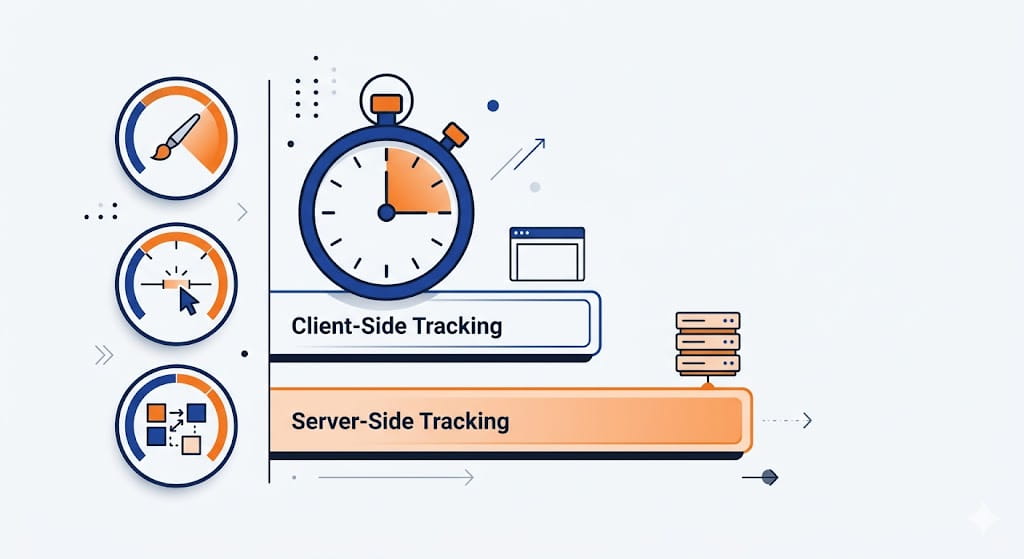
TEST SETUP AND WHAT WE MEASURED
To evaluate server-side vs client-side tracking in a meaningful way, we need to move beyond theory and isolate measurable performance indicators.
This benchmark is based on three common site archetypes:
Shopify product detail page (high eCommerce interaction) Content-heavy publishing site (high pageview volume, low conversion density) SaaS landing page (high intent, form-based conversion flow)
For each environment, we measured:
LCP (Largest Contentful Paint) INP (Interaction to Next Paint) Total blocking time contribution from tags Event delivery success rate under ad blockers Server response latency (for sGTM setups) Cost per 1,000 events at scale
The goal is not to prove one approach is universally better, but to quantify trade-offs under real constraints.
LCP AND INP IMPACT ON A SHOPIFY PDP
On high-intent Shopify product pages, tracking scripts often compete directly with rendering performance.
Client-side tracking impact:
Multiple third-party scripts load in parallel (Meta, GA4, TikTok, etc.) Increased main-thread blocking time during initial load Slight degradation in INP due to script execution overhead Tag sequencing can delay interactivity under heavy load
Server-side tracking impact:
Reduced client-side script weight Lower main-thread execution during page load Improved INP stability due to fewer active browser tags Slight LCP improvement due to reduced JS parsing overhead
Key observation:
Server-side tracking does not directly improve rendering, but it reduces client-side execution pressure, which indirectly stabilizes performance metrics.
The improvement is most visible on mobile devices and slower CPUs.
EVENT DELIVERY RELIABILITY UNDER AD BLOCKERS
One of the most measurable differences between client-side and server-side tracking is event delivery success rate under ad blocker conditions.
Client-side tracking:
High failure rate on pages with active ad blockers GA4 and Meta pixels frequently blocked or partially executed Inconsistent event capture across sessions Significant data loss in privacy-heavy browsers
Server-side tracking:
Events routed through first-party infrastructure Lower detection by browser-based blocking tools Higher delivery success rate for conversion events Improved consistency in attribution datasets
However:
Server-side tracking is not immune to blocking. Advanced privacy tools and network-level filtering can still reduce visibility, especially if endpoint patterns are recognized.
The key difference is resilience, not invincibility.
MOBILE SAFARI AND THE IOS EDGE
Mobile Safari introduces one of the most challenging environments for tracking due to Intelligent Tracking Prevention (ITP) and privacy restrictions.
Client-side limitations:
Cookie lifespan restrictions (7-day or less in some cases) Reduced third-party tracking persistence Intermittent script execution under strict privacy settings Higher likelihood of session fragmentation
Server-side advantages:
First-party context improves cookie persistence Reduced reliance on browser-based storage More stable event forwarding via server infrastructure Better resilience against ITP-related degradation
Important nuance:
Server-side tracking does not bypass iOS privacy rules-it reduces dependence on browser storage, which is the primary point of failure in client-side setups.
COST-PER-EVENT AT SCALE
Cost is often overlooked in performance comparisons, but it becomes critical at scale.
Client-side tracking costs:
Lower infrastructure cost (browser handles execution) Higher data loss cost (missed conversions, incomplete attribution) No server compute expense
Server-side tracking costs:
Infrastructure costs (hosting, compute, network requests) Event processing and routing overhead Potential scaling costs under high traffic volumes
At scale (millions of events per month):
Server-side costs become predictable but non-trivial Client-side remains cheaper in infrastructure terms But client-side losses can create hidden revenue attribution gaps
The real comparison is not cost per event alone, but cost per reliable event.
WHEN THE NUMBERS SAY MIGRATE AND WHEN THEY DON'T
Server-side tracking is not a universal upgrade. The decision depends on performance bottlenecks, data loss tolerance, and infrastructure maturity.
You should migrate when:
Ad blocker loss significantly impacts attribution accuracy iOS traffic represents a large portion of users Conversion tracking inconsistencies are visible across platforms Page performance is affected by tag-heavy client-side scripts You require centralized governance of tracking logic
You should not migrate when:
Traffic volume is low and data loss is negligible Existing client-side setup is stable and accurate Engineering resources are limited for maintenance Attribution discrepancies are already well-understood and acceptable Business decisions do not depend on high-fidelity tracking precision
Key principle:
Server-side tracking is most valuable when tracking failure becomes more expensive than infrastructure complexity.
FINAL THOUGHTS
The comparison between server-side and client-side tracking is not a binary performance debate-it is a systems trade-off between reliability, control, and cost.
Client-side tracking is simpler and cheaper but increasingly fragile in privacy-constrained environments. Server-side tracking improves resilience and data integrity but introduces infrastructure complexity and operational cost.
The real decision is not which is better, but which failure mode your business can tolerate: lost data or increased system complexity.
Topics: server-side tracking performance, client-side tracking, GTM server-side, tracking benchmarks, LCP INP impact, ad blocker tracking, Analytics Infrastructure
More articles on the Samarth Analytics blog · Markdown version of this article