First-Purchase vs Repeat-Purchase Funnels: Two Different Businesses
By Samarth Analytics · Published · Updated · E-commerce Analytics · 15 min read
Summary: A strategic exploration of the fundamental divergence between acquiring a new customer and retaining an existing one. This guide provides a segmented funnel framework to identify specific drop-off patterns, technical steps for robust GA4 segmentation, and an analysis of how retention-led growth via email and SMS requires its own distinct optimization logic.
Why blended funnels hide half the story
In the realm of E-commerce Analytics (ECA), the "blended conversion rate" is perhaps the most dangerous vanity metric an organization can track. When you look at a dashboard that shows a 3% conversion rate, you are viewing an average of two diametrically opposed worlds. One world consists of people who have never heard of you, and the other consists of people who have already given you their credit card information. To treat these two groups as a single "funnel" is a failure of Analytics Architecture.
The "Blended Data Delusion" masks the true health of your business. For instance, if your blended conversion rate remains steady at 3%, you might assume your marketing is performing well. However, if your repeat purchase funnel is carrying the weight while your first-purchase conversion rate is plummeting, your business is effectively "dying from the top." You are failing to acquire new blood, and eventually, the pool of existing customers will churn out. Conversely, if your first-purchase rate is high but your repeat rate is zero, you are running a "leaky bucket" operation where your Customer Acquisition Cost (CAC) will eventually swallow your margins.
In 2026, sustainable e-commerce requires a "Bifurcated View." You must acknowledge that the psychology of a first-time buyer is rooted in Trust and Risk Mitigation, while the psychology of a repeat buyer is rooted in Convenience and Recognition. By separating these funnels, you can apply specific CRO (Conversion Rate Optimization) tactics that address the unique friction points of each group, rather than applying a "middle-of-the-road" strategy that serves neither.
Segmenting new vs returning in GA4
To move beyond blended data, you must master the technical nuances of segmentation in GA4. While Google provides a default "New vs. Returning" dimension, relying on it blindly can lead to inaccuracies due to cookie expiration and cross-device usage.
To build a professional-grade repeat purchase funnel analysis, we recommend the following technical steps:
User ID Implementation: This is non-negotiable. By passing a hashed version of the customer’s internal ID (from Shopify or your CRM) to GA4, you can stitch together sessions across mobile, desktop, and app. This ensures that a "New" user on a laptop isn't counted as "New" again when they return on their phone.
First User Source/Medium: Use the "First User" scoped dimensions to understand how a customer was originally acquired, even when they are returning via a "Direct" or "Email" session. This allows for long-term LTV (Lifetime Value) attribution that standard session-scoped reports miss.
The "Purchase Count" User Property: Register a custom user property that tracks the number of times a user has purchased. This allows you to create high-fidelity audiences: "Users with 0 Purchases" (The Acquisition Funnel) and "Users with 1+ Purchases" (The Retention Funnel).
In Analytics Engineering (AE), we use these segments to create "Calculated Metrics" for each funnel. Your "First-Purchase Conversion Rate" should only use the sessions of users who have never bought before. Your "Repeat Purchase Rate" should only look at the cohort of users who already exist in your database. Only then can you see the "True North" of your growth engine.
Typical first-purchase drop-off patterns
The journey of a first-time buyer is a battle against skepticism. Because the user has no history with your brand, every step of the funnel is a potential "Exit Point" caused by a lack of trust. In our CRO audits, we consistently see three primary drop-off patterns in the first-purchase journey:
- The "Information Friction" Gap New users spend significantly more time on the "Shipping & Returns" and "About Us" pages than returning users. If this information is hidden or vague, the user drops off at the Product Detail Page (PDP). They aren't ready to buy yet; they are still "vetting" the business.
Fix: Place "Zero-Risk" signals (Free Returns, Money-Back Guarantee) directly under the "Add to Cart" button for new users.
- The "Social Proof" Requirement A first-time buyer rarely trusts your marketing copy. They look for the "unfiltered" voice of other customers. A drop-off at the "Add to Cart" stage often indicates a lack of credible reviews or user-generated content (UGC) for that specific SKU.
Fix: Use dynamic content to show "Verified Buyer" reviews more prominently to users in their first session.
- The "Account Creation" Wall Forcing a new user to "Create an Account" before they can see the shipping cost is a conversion killer. It signals a "long-term commitment" that the user hasn't agreed to yet.
Fix: Implement "Guest Checkout" as the primary path for first-time buyers, capturing their email only at the very end of the process.
Typical repeat-purchase drop-off patterns
When a customer returns to your site, their skepticism has been replaced by an expectation of efficiency. They already know your product works; now they want it with the least amount of effort possible. The repeat purchase funnel fails not because of a lack of trust, but because of a "Friction Gap."
- The "Login" Barrier If a returning user is treated like a stranger and forced to "Sign In" to see their previous orders or saved address, they may abandon. In 2026, "Passwordless Login" via magic links or SMS codes is the gold standard for retention.
Fix: Use "Persistent Login" cookies or "Recognized User" states to pre-fill their name and shipping details.
- The "Irrelevant Discovery" Problem If your homepage shows a "New Customer Bundle" to a user who has already bought that bundle three times, you are wasting the session. They are looking for "What's Next" or a "Quick Reorder" of their staples.
Fix: Use ECA data to change the homepage hero image for returning customers to highlight "Complementary Products" or a "Subscription Upgrade."
- The "Shipping Surprise" Returning customers often assume they will get the same deal they got last time. If you have changed your shipping thresholds or loyalty points logic without clearly communicating it, they will drop off at the final "Payment" step out of a sense of "Betrayal."
Fix: Display "Loyalty Balance" or "Exclusive Member Shipping" early in the cart to reinforce the value of their return.
Email and SMS as part of the repeat funnel
In the repeat purchase funnel, your website is rarely the "Starting Point" of the journey. Instead, the journey begins in the inbox or the text message thread. These channels act as the "External Funnel" that feeds the site.
In 2026, a "One-Size-Fits-All" email strategy is a liability. Your Analytics Architecture should inform your "Post-Purchase Flows" based on the specific product purchased.
The "Replenishment" Flow: If you sell a 30-day supply of vitamins, an SMS at Day 25 is a critical part of the funnel.
The "Cross-Sell" Flow: If they bought a coffee machine, the funnel for their next purchase (coffee beans) should be educational and automated.
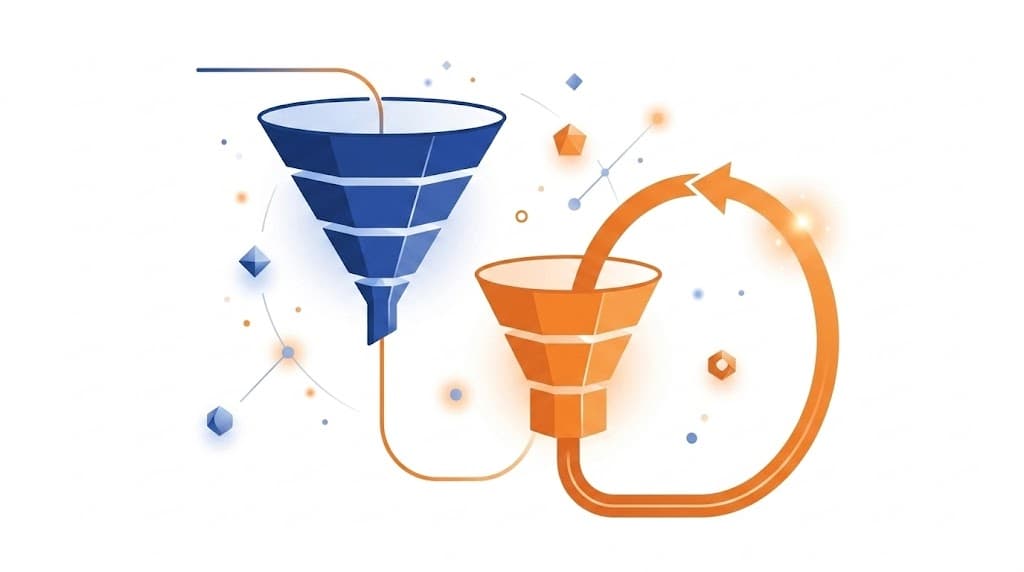
The key to CRO in the repeat funnel is "Zero-Party Data." Use your post-purchase surveys to ask: "When do you plan to use this?" or "What is your primary goal?" This data should flow from your site back into your email service provider (ESP) to create a "Circular Funnel" that keeps the customer in a constant state of "Nurtured Intent."
Subscription lifecycle as a special case
For brands with a subscription component, the repeat purchase funnel takes on a specialized, high-stakes form. The "Conversion" is no longer a single transaction, but the "Successful Renewal."
In this case, the ECA audit must look at the "Subscription Health" metrics:
The "Pre-Churn" Signal: Is the user logging in less frequently? Are they "Skipping" deliveries?
The "Dunning" Funnel: What happens when a credit card fails? This is a "Technical Funnel" that requires its own optimization to prevent "Involuntary Churn."
The "Reactivation" Funnel: This is the journey of a user who cancelled six months ago. They are not a "New" user, but they aren't an "Active" user either. They require a "Re-Discovery" narrative that acknowledges their previous history while offering a "New" reason to return.
Subscription businesses are "Compound Interest" businesses. Small improvements in the renewal funnel have a 10x impact on LTV compared to similar improvements in the acquisition funnel.
Two dashboards, not one
The final stage of this framework is to physically separate your reporting. You cannot manage "Two Different Businesses" with one dashboard. You need a "Two-Tab" or "Two-Report" approach in your Cloud Data (CD) warehouse.
Dashboard A: The Acquisition Engine
Primary KPI: First-Purchase CPA (Customer Acquisition Cost).
Focus: Channel efficiency, landing page performance, and "Trust Signal" engagement.
Goal: Feed the machine with new customers at a profitable rate.
Dashboard B: The Retention Engine
Primary KPI: LTV:CAC Ratio and Repeat Purchase Rate.
Focus: Churn, subscription health, email/SMS click-through-to-buy, and "AOV Expansion."
Goal: Maximize the value of every customer acquired.
By separating these views, you allow your "Growth Team" to focus on the battle of acquisition while your "Retention Team" focuses on the war of LTV. This ensures that the specific logic needed for the repeat purchase funnel is never diluted by the requirements of the acquisition funnel.
Final thoughts
Acquiring a customer is a transaction; keeping a customer is a relationship. In the modern e-commerce landscape, the brands that win are those that understand the fundamental difference between these two states. The repeat purchase funnel is not a "sequel" to the acquisition funnel; it is a separate architecture with its own psychology, its own friction, and its own technical requirements.
By mastering the art of segmentation in GA4, identifying the distinct drop-off patterns of new and returning users, and building a bifurcated reporting system, you move beyond "Blended Mediocrity" and into "Segmented Excellence."
Your data should reflect the reality of your customers' lives. Some are strangers, some are friends, and some are loyalists. Treat them accordingly, and your bottom line will reflect the value of those relationships.
Topics: LTV optimization, e-commerce growth, subscription commerce, CAC analysis, repeat purchase funnel, CRO, customer retention, ECA, GA4 strategy, Analytics Architecture
More articles on the Samarth Analytics blog · Markdown version of this article