Consent-Aware Tag Firing: Integrating Your CMP Without Breaking Tracking
By Samarth Analytics · Published · Updated · Tag Management · 19 min read
Summary: A deep implementation guide for building consent-aware tag firing in Google Tag Manager using CMPs like OneTrust or Cookiebot. This article explains how to structure consent categories, integrate Consent Mode v2, align triggers correctly, and ensure tracking continuity without violating privacy requirements or breaking attribution systems.
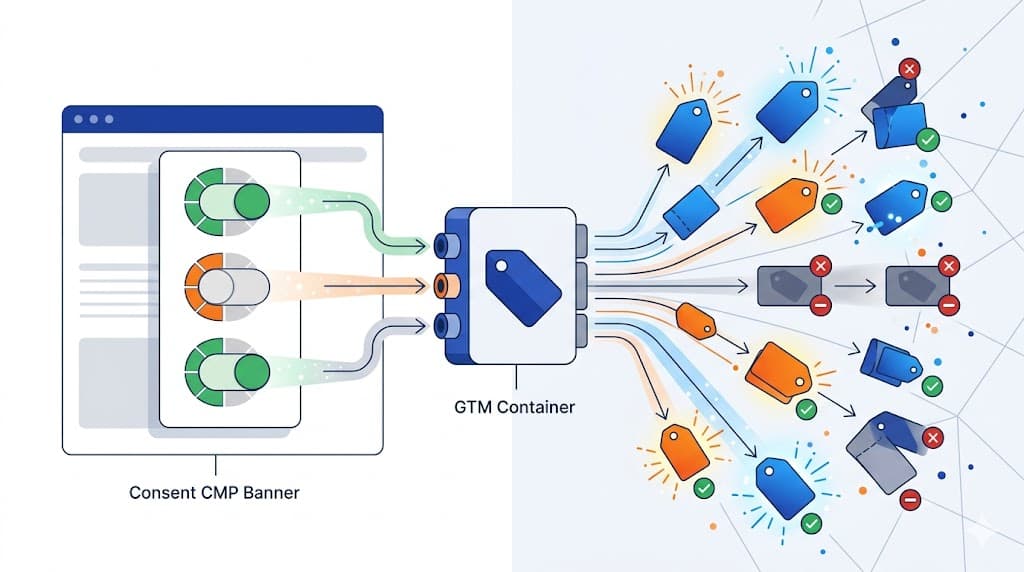
THE TWO FAILURE MODES OF CMP + GTM IMPLEMENTATIONS
Most consent and tracking implementations fail in predictable ways. The issue is not complexity-it is misalignment between consent systems and tracking execution logic.
There are two dominant failure modes.
Failure Mode 1: Over-Restriction (Tracking Collapse)
This happens when consent enforcement is too aggressive or incorrectly mapped into GTM logic.
What it looks like in practice: GA4 traffic drops by 30–80% after CMP rollout Paid conversions disappear or collapse Remarketing audiences shrink dramatically Server-side tracking shows lower-than-expected volume Dashboards suddenly look “broken” Why it happens: Tags are blocked even after consent is granted GTM does not re-evaluate updated consent state CMP events are not properly pushed into dataLayer Consent categories are mapped incorrectly Business impact:
This is often misinterpreted as a marketing performance issue.
In reality:
The business is still performing The measurement layer is broken
This leads to bad decisions like:
Reducing ad spend Changing campaigns unnecessarily Misreading channel performance Failure Mode 2: Under-Restriction (Compliance + Data Integrity Risk)
This is the opposite failure mode and often more dangerous legally.
What it looks like: Tracking tags fire even without consent Pixels load before CMP initialization Hardcoded scripts bypass GTM controls Cookies are set without permission Causes: Scripts outside GTM container Missing consent checks on legacy tags CMP not connected to GTM properly Incorrect default consent state Business risk: GDPR violations ePrivacy breaches Invalid user-level tracking Audit exposure
This is not just a technical issue-it becomes a legal liability.
CONSENT CATEGORIES YOU ACTUALLY NEED (NOT CMP OVERCOMPLEXITY)
Most CMPs expose 10–20 categories. In reality, GTM systems only need a minimal functional taxonomy.
Overengineering consent categories is one of the most common implementation mistakes.
- Necessary (Always Active)
This category is non-negotiable.
Includes:
Security cookies Session handling Authentication systems Load balancing Fraud prevention
These are not part of analytics logic and should never be blocked.
- Analytics Consent
This governs measurement systems.
Includes:
GA4 Product analytics tools Heatmaps (Hotjar, Clarity, etc.) Funnel tracking systems Event tracking pipelines
If this is denied:
No behavioral analytics should execute No user-level tracking should persist 3. Marketing Consent
This is the most commercially sensitive category.
Includes:
Meta Pixel and CAPI Google Ads tags TikTok tracking Retargeting scripts Affiliate tracking systems
If denied:
No advertising identifiers should be stored No audience-building tags should fire 4. Personalization Consent (Optional but common in e-commerce)
Includes:
Recommendation engines Dynamic content personalization On-site targeting tools
This category is optional but often used in scaling e-commerce setups.
Why Simplicity Wins
A simplified consent structure ensures:
Cleaner GTM triggers Easier debugging Predictable tag behavior Fewer integration errors Better CMP-to-GTM mapping
Complex consent taxonomies create implementation ambiguity, which is the root cause of most tracking failures.
TRIGGERING TAGS BY CONSENT STATE (NOT COOKIES)
A critical architectural mistake is using cookies as the control mechanism for tag firing.
This approach fails in modern environments.
Why cookie-based logic is broken: Cookies are deleted by Safari Intelligent Tracking Prevention Firefox limits cross-site storage Ad blockers interfere with cookie writes Server-side GTM does not share browser cookies Consent updates do not reliably update cookies Correct approach: Consent state is the source of truth
Instead of reading cookies, GTM should rely on explicit consent state signals.
Execution flow: CMP initializes on page load Consent state is stored in memory or dataLayer GTM listens for consent update events Tags evaluate consent state before firing Example behavior model: analytics = granted → GA4 fires marketing = granted → Ads pixels fire denied → no non-essential tags execute Why this architecture is stable:
Consent state is:
Explicit Event-driven Centralized Consistent across environments
Cookies are none of those things.
CONSENT MODE V2: HOW GOOGLE ACTUALLY HANDLES PRIVACY SIGNALS
Consent Mode v2 is not a toggle-it is a behavior modification system for Google tags.
Core signals: ad_storage analytics_storage ad_user_data ad_personalization
Each signal affects how Google collects or models data.
When consent is DENIED:
Google tags:
Do not store cookies Do not create persistent identifiers Send anonymized or restricted signals Use statistical modelling for attribution
Important insight:
Tracking does NOT stop-it shifts to modeled inference.
When consent is GRANTED:
Google tags:
Fully activate cookie storage Enable deterministic attribution Improve conversion tracking accuracy Build full audience data sets Critical implementation requirement:
Consent Mode must initialize before any Google tag fires.
If not:
First page view may bypass consent rules GA4 data becomes inconsistent Modeled attribution becomes unreliable
This is one of the most common production errors.
GTM ARCHITECTURE FOR CONSENT-AWARE TAG FIRING
A stable implementation follows a strict execution hierarchy.
Step 1: CMP loads first Consent banner renders Default state is applied
No tags should fire before this step.
Step 2: Consent state initialization Stored in dataLayer or CMP API Initial state is defined (granted/denied/default) Step 3: GTM initializes Consent Mode Google signals are set Default restrictions applied Step 4: Tags evaluate consent state
Each tag checks:
analytics consent marketing consent personalization consent Step 5: Consent updates propagate dynamically
When user changes preferences:
GTM re-evaluates triggers Tags adjust behavior in real-time Key principle:
Consent is not static. It is an event-driven state system.
TESTING CONSENT BEHAVIOR IN GTM PREVIEW
Testing is where most implementations fail.
You must simulate real user journeys.
Scenario 1: No consent granted
Expected:
Only necessary tags fire GA4 remains blocked or restricted Ads tags do not execute
Validate:
Network tab GTM debug panel CMP state logs Scenario 2: Partial consent (analytics only)
Expected:
GA4 fires normally Ads tags remain blocked No remarketing scripts load Scenario 3: Full consent granted
Expected:
All tags fire Cookies are enabled Attribution is fully functional Scenario 4: Consent revoked
Expected:
New tags stop firing State updates propagate Historical data remains unchanged Advanced test case: Cross-session behavior
Test:
Returning user behavior Consent persistence across sessions Subdomain consistency VERIFYING TAG BEHAVIOR MATCHES CMP UI
This is a critical compliance requirement.
Step 1: UI verification
Confirm:
Consent toggles reflect correct states Default opt-in behavior is valid No pre-checked marketing consent exists Step 2: GTM verification
Check:
dataLayer consent events trigger evaluation logs consent state updates Step 3: Network verification
Inspect:
GA4 requests Meta Pixel calls third-party scripts
Mismatch between UI and network behavior = broken system.
Step 4: Cross-domain verification
Ensure:
Consent is consistent across subdomains No state reset occurs on navigation Server-side GTM respects browser consent SERVERSIDE TRACKING AND CONSENT CONTINUITY
Consent logic must extend beyond the browser.
Server-side responsibilities: Receive consent state from client Filter outgoing events Suppress restricted identifiers Maintain compliance across APIs Why this matters:
If server-side GTM ignores consent:
Data becomes non-compliant Platforms receive invalid signals Attribution becomes legally questionable COMMON IMPLEMENTATION FAILURES
- GTM loads before CMP
Breaks entire consent chain.
- Hardcoded scripts outside GTM
Bypasses consent enforcement completely.
- Incorrect mapping
Analytics tied to marketing consent or vice versa.
- Missing initialization of Consent Mode v2
Leads to uncontrolled first-hit tracking.
- Multi-domain inconsistency
Consent not shared across subdomains or checkout flows.
WHY THIS SYSTEM IMPROVES DATA QUALITY (NOT JUST COMPLIANCE)
A correct implementation improves:
Attribution accuracy Conversion modelling stability Cross-platform consistency Paid media optimization quality Dashboard reliability
Consent systems are not just legal safeguards-they are data filters that improve signal quality.
FINAL THOUGHTS
Consent-aware tag firing is a foundational layer of modern analytics architecture.
When properly implemented:
Tracking respects user intent Attribution remains stable via Consent Mode modelling GTM behaves deterministically across environments Server-side and client-side tracking remain aligned
The objective is not maximum data collection.
It is controlled, compliant, and reliable measurement that can withstand both regulatory scrutiny and platform-level privacy constraints.
Topics: OneTrust integration, GTM consent mode v2, consent-aware tag firing, Cookiebot GTM setup, tag management governance, privacy compliance tracking, server-side tracking
More articles on the Samarth Analytics blog · Markdown version of this article