Cart Abandonment Attribution: Email, SMS, and Retargeting Untangled
By Samarth Analytics · Published · Updated · E-commerce Analytics · 4 min read
Summary: A structured framework for resolving attribution conflicts in cart abandonment journeys across email, SMS, and paid retargeting. This guide explains how Klaviyo, Attentive, and Meta overlap in claiming conversions, and how to use GA4 as the neutral attribution layer to build a clean, defensible reporting model.
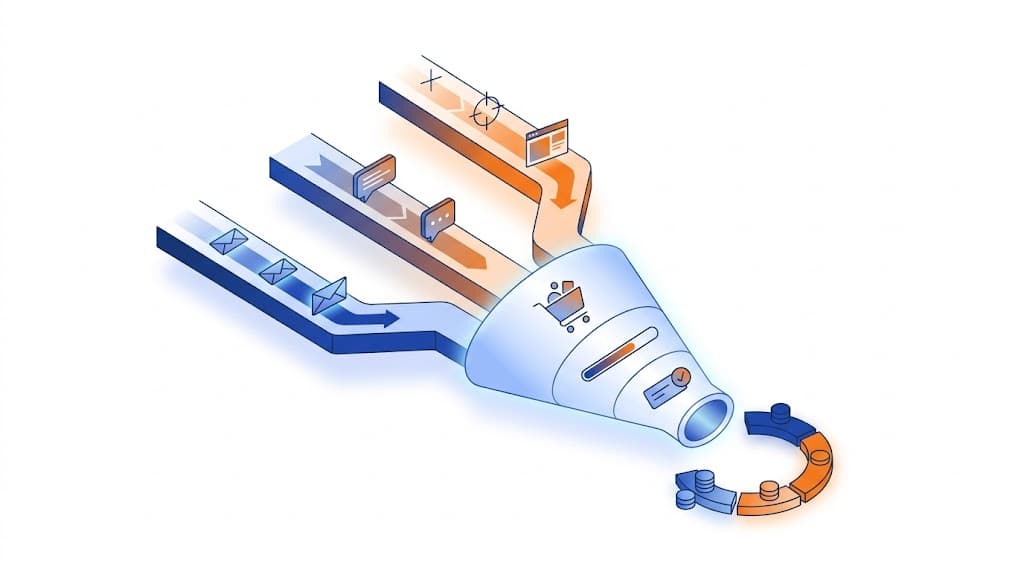
THE TRIPLE-CLAIM PROBLEM
Cart abandonment is one of the most contested areas in marketing attribution. The same conversion is often claimed simultaneously by email, SMS, and paid retargeting systems.
A typical journey looks like this:
User adds product to cart Leaves the site without purchasing Receives an email reminder (Klaviyo) Receives an SMS reminder (Attentive or similar tool) Sees a Meta retargeting ad Returns and completes purchase
After conversion, all three systems report success.
Email claims: “Recovered cart” SMS claims: “Recovered sale” Meta claims: “Retargeting conversion”
The problem is not tracking failure-it is attribution duplication.
Each platform is optimized to take credit, not to coordinate credit. Without a neutral system, reporting becomes inflated and misleading.
The solution is not removing channels, but defining attribution hierarchy.
UTM HYGIENE ACROSS CHANNELS
The foundation of clean attribution is consistent UTM discipline across all recovery channels.
Without strict UTM hygiene, GA4 cannot reliably distinguish between touchpoints.
Common UTM structures:
Email (Klaviyo)
utm_source=klaviyo utm_medium=email utm_campaign=cart_abandonment
SMS (Attentive or similar)
utm_source=attentive utm_medium=sms utm_campaign=cart_abandonment
Paid Retargeting (Meta)
utm_source=meta utm_medium=paid_social utm_campaign=retargeting_cart
Key rules:
Never reuse UTM campaigns across different channels Always standardize naming conventions Avoid dynamic overwrites that mask original intent Ensure consistency between CRM tools and ad platforms
Without UTM discipline, GA4 attribution becomes unreliable and impossible to audit.
GA4 AS SOURCE OF TRUTH
In multi-channel cart recovery systems, GA4 should act as the neutral attribution layer.
Unlike Klaviyo, Attentive, or Meta, GA4 does not have a financial incentive to claim conversions. Instead, it evaluates all touchpoints within a structured attribution model.
GA4 advantages:
Unified cross-channel session tracking Flexible attribution models (data-driven, last click, position-based) Event-level visibility across all touchpoints Consistent reporting across marketing stack
However, GA4 is only reliable if:
UTM tagging is consistent Session continuity is preserved Cross-domain tracking is correctly configured Consent mode is properly implemented
GA4 does not eliminate attribution conflict-it standardizes it into a measurable framework.
POSITION-BASED VS LAST-CLICK FOR RECOVERY
Attribution model selection dramatically changes how cart recovery performance is interpreted.
Last-click attribution
Gives full credit to the final touchpoint Often overvalues SMS or retargeting ads Undervalues email nurturing sequences Simplifies reporting but distorts contribution
Position-based attribution
Assigns higher weight to first and last interactions Distributes credit across mid-funnel touches Better reflects assisted conversions More accurate for multi-channel journeys
For cart abandonment flows, position-based models are generally more realistic because:
Email often initiates recovery SMS reinforces urgency Ads close the conversion
Last-click attribution hides this distribution and leads to channel bias in decision-making.
KLAVIYO AND ATTENTIVE TRACKING PATTERNS
Email and SMS platforms track conversions using their own internal attribution windows and tracking mechanisms.
Klaviyo (Email)
Uses click-based attribution by default Applies configurable lookback windows Often inflates direct recovery impact May override GA4 session attribution in reports
Attentive (SMS)
Typically uses short attribution windows High last-touch bias due to immediacy of SMS clicks Strong conversion association even if assist occurred earlier
Key issue:
Both systems operate independently from GA4 session logic. This creates parallel attribution models that do not reconcile automatically.
Without a unified model, each platform will report inflated contribution to revenue.
REPORTING TEMPLATE
To resolve attribution conflicts, a unified reporting structure is required that clearly separates roles rather than assigning overlapping credit.
A clean reporting template includes:
- Assisted conversions view
Email assists SMS assists Paid retargeting assists
- Last-click conversions view
Final touch attribution only Used for budgeting decisions
- GA4 model comparison
Data-driven attribution results Position-based attribution results Channel contribution overlap
- Incrementality proxy view
Lift from combined channel exposure Reduction in abandoned carts over time Conversion rate changes by exposure sequence
This structure ensures:
No double counting across platforms Clear understanding of channel roles Separation of assist vs closure logic
The goal is not a single “winner,” but a structured view of contribution.
FINAL THOUGHTS
Cart abandonment attribution is not a tracking problem-it is a governance problem across multiple marketing systems that all optimize for credit.
Email, SMS, and paid retargeting each play a valid role in recovery, but without a neutral attribution layer like GA4, reporting becomes inflated and inconsistent.
A structured approach using strict UTM hygiene, GA4 as the source of truth, and multi-model attribution analysis ensures that each channel is evaluated fairly based on its true contribution to recovery rather than its position in the last click.
Topics: Klaviyo tracking, eCommerce analytics, multi-touch attribution, GA4 attribution model, cart abandonment attribution, Meta ads attribution, SMS marketing attribution
More articles on the Samarth Analytics blog · Markdown version of this article