Attribution Leaks: Identifying and Fixing Common Cross-Channel Gaps
By Samarth Analytics · Published · Updated · Conversion Tracking · 6 min read
Summary: Attribution rarely fails all at once - it leaks, one stripped parameter and one misclassified referral at a time, until direct traffic swallows a third of your conversions. This guide provides a taxonomy of the most common cross-channel attribution leaks in 2026, a systematic leak audit method for your Analytics Architecture (AA), and the order of operations for fixing them so the highest-spend channels get clean credit first.
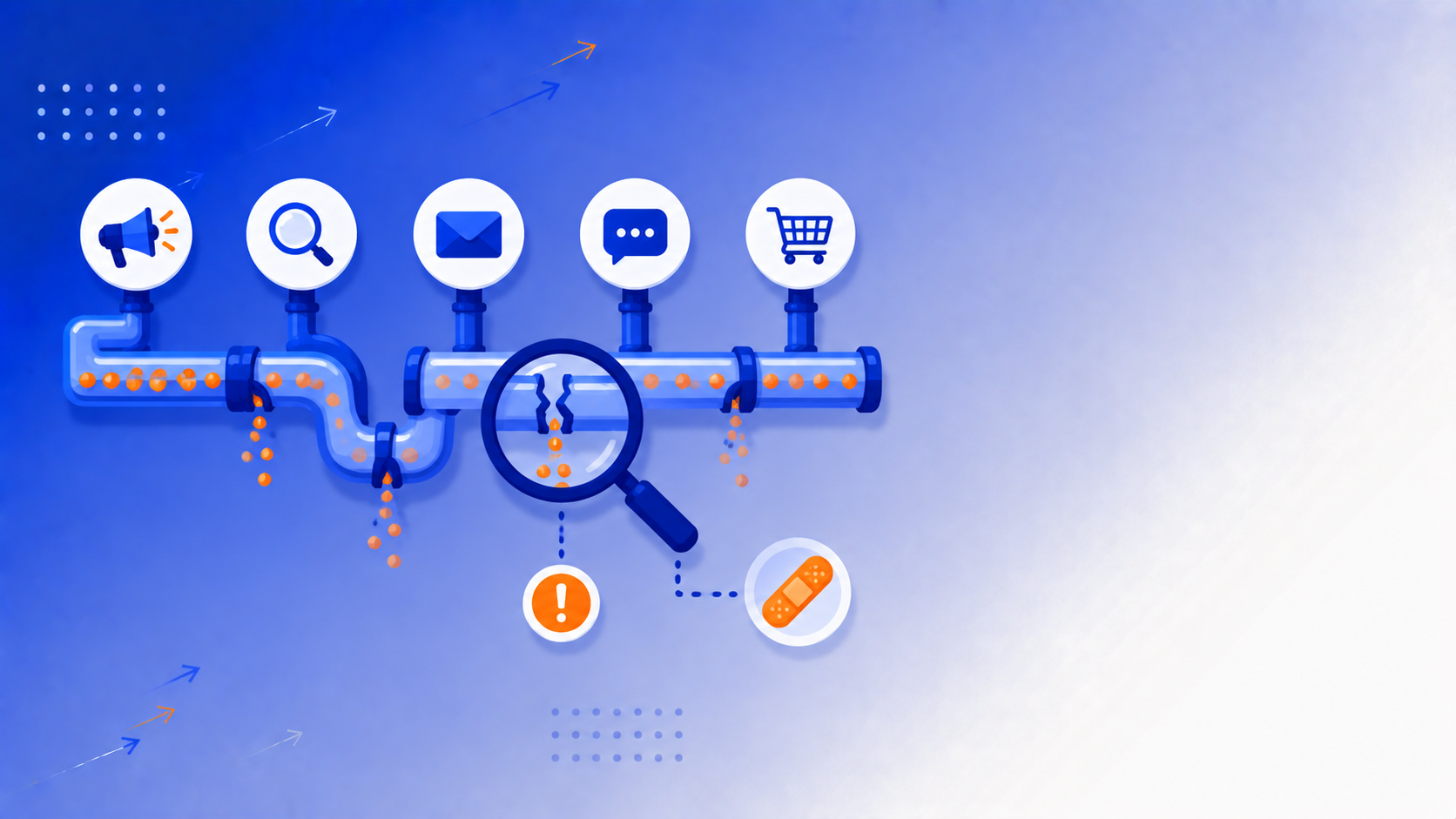
Attribution does not break - it leaks
When attribution fails catastrophically - a tag deleted, a pixel misfiring - someone notices within days. The far more expensive failure is the slow one: attribution that leaks. A redirect strips a parameter here, a payment gateway overwrites a session source there, and eighteen months later 38% of your conversions sit in "direct / none" while the channels that actually drove them get starved of budget in the next planning cycle.
We call this cumulative erosion "Attribution Drift" - the gap between where credit should land and where it actually lands, widening one small defect at a time. No single leak looks urgent, which is exactly why they persist. In our audits, a mid-market account typically carries four to seven active leaks, and the largest single one usually misattributes more revenue than the entire analytics budget.
In 2026, with modeled conversions and consent-driven gaps already blurring the picture, you cannot afford to add self-inflicted leaks on top. This post is a field taxonomy of the leaks we find most often, and a method for hunting them down in your own stack - regardless of whether you run client-side or server-side tagging.
Leak type 1 - redirects and parameter stripping
The most common leak is the most mechanical: a URL passes through a redirect that drops its query string. Link shorteners, legacy vanity URLs, http-to-https hops, country redirects, and single sign-on flows are all repeat offenders. The click leaves the ad platform fully tagged and arrives at the site naked, and GA4 dutifully records a direct session.
The diagnostic is simple: take the top 20 destination URLs from every major campaign and paste them into a redirect checker, watching whether utm parameters and click IDs survive every hop. In one audit, a client's entire Meta prospecting budget - roughly 60,000 euros a month - was landing through a geo-redirect that discarded query strings, which explained a "mysterious" 25% direct traffic share almost by itself.
The fix belongs to whoever owns the redirect: configure it to forward query strings, or better, eliminate intermediate hops entirely. This is a one-line server change that routinely reclassifies five-figure monthly revenue.
Leak type 2 - payment gateways and checkout detours
Any journey that leaves your domain and returns - PayPal, iDEAL, Klarna, 3D Secure bank verification - risks starting a fresh session attributed to the gateway. The user arrives from a paid search ad, pays via their bank's verification page, returns to your thank-you page, and the purchase credits "bankname.com / referral". Paid search loses the conversion; a channel nobody buys media on gains it.
The primary fix is GA4's referral exclusion mechanism: list every payment and verification domain your checkout can route through under unwanted referrals. The subtle part is completeness - buy-now-pay-later providers and regional bank verification domains multiply quietly, so re-derive the list quarterly from a report of referral sources that convert with unusually short session durations and near-100% purchase rates. A "referrer" that converts at 90% is not a channel; it is a leak signature.
Leak type 3 - app-to-web handoffs and the in-app browser problem
Journeys that cross from apps into web are 2026's fastest-growing leak category. A user taps a link in Instagram, LinkedIn, or your own app, and the destination opens in an in-app browser with its own cookie jar. If they later reopen the site in Safari or Chrome to complete the purchase, they arrive as a brand-new direct user with no memory of the campaign that started the journey.
You cannot fully seal this one, but you can shrink it:
Deep link hygiene: Ensure links out of your own app carry campaign parameters and, where supported, open the system browser rather than a webview.
First-party stitching: Encourage early login or email capture, so the identity crossing the browser boundary carries the journey with it via user_id.
Honest annotation: For social in-app traffic you cannot stitch, document the expected loss rate so stakeholders read direct traffic movements with appropriate suspicion.
The goal here is not perfection - it is knowing the size of the hole rather than pretending it does not exist.
Leak type 4 - dark social and the email prefetch trap
Two quieter leaks round out the taxonomy. "Dark social" - links shared through WhatsApp, Slack, DMs, and native share sheets - arrives with no referrer at all and pools into direct. The partial remedy is instrumenting your own share buttons with tagged URLs, so at least the shares you facilitate stay visible; a sudden direct-traffic spike on a specific deep URL is usually dark social, not a tracking failure.
Email adds an inverted problem: inflation. Security scanners and mail clients prefetch links before any human clicks, firing your tags into the void. If your email platform reports a 40% click rate but GA4 sessions from those sends convert at a fraction of historical norms, machines are clicking your links. Mitigate by measuring email on post-click engagement rather than raw arrival, and by filtering known scanner patterns - clusters of sub-one-second sessions hitting within seconds of a send - out of reporting.
Running the leak audit - and fixing in the right order
Individually, none of these checks is hard. The discipline is running them as a system. Our leak audit follows three passes:
Pass 1 - quantify the pool: Measure the direct/none share of conversions by device and by landing page. Direct conversions landing on deep product URLs are almost always misattributed arrivals; nobody types those by hand.
Pass 2 - fingerprint the leaks: Each leak type has a signature. Stripped parameters show as direct entrances on campaign landing pages. Gateway leaks show as high-converting referrals. Prefetch shows as sub-second email sessions. Map each anomaly to a leak type before touching anything.
Pass 3 - fix by spend at risk, not by ease: Order the fixes by the media budget flowing through each broken path. A redirect on your biggest paid channel outranks a tidy referral exclusion for a gateway used in 2% of orders.
Then re-baseline: annotate each fix date in your Analytics Architecture (AA), and expect channel numbers to shift as credit flows back to its rightful owners. A Custom Dashboard (CD) tracking the direct/none conversion share weekly is your ongoing leak alarm - when the line creeps up, something new has sprung.
Final thoughts
Attribution leaks are unglamorous, mechanical, and collectively enormous. No single stripped parameter will ever make it onto a leadership agenda, yet in aggregate they decide which channels look profitable - and therefore where next quarter's budget goes. The audit method is not sophisticated: quantify the direct pool, fingerprint the anomalies, fix in order of spend at risk, and watch the drift reverse.
In 2026, the teams with trustworthy attribution are not the ones with fancier models; they are the ones who plugged their leaks. If your direct traffic share has been quietly climbing and nobody can explain why, a free GA4 audit is the fastest way to find out where the credit is escaping.
Budget follows attribution. Make sure yours is following the truth.
Topics: email prefetch, dark social, attribution leaks, AA, app-to-web tracking, leak audit, utm parameters, CD, direct traffic inflation, payment gateway referrals
More articles on the Samarth Analytics blog · Markdown version of this article